Working as an event coordinator for “Starling Fashion Events”, a fictitious event planning company, whom have been hired to organize and put on a fashion show event by clients, “Molten Lava and Elegenza Accessories” — also pitching strategies, etc. to convince the brands’ owner, “Jenny”, to work with our team. Every detail of the event has been strategically designed: from the makeup and fashion looks, venue (location, theme, decor), the staff and their duties, guest list, seating arrangements, exact runway timing and order of looks the models walk down the runway, down to the fact sheets/calendar of events, etc. This project shows my dedication and research skills, attention to detail, creative design techniques, ability to think outside the box, as well as configuring and planning specific content strategies.
Fashion show Event Planning, runway coordination, Inspirations and Research
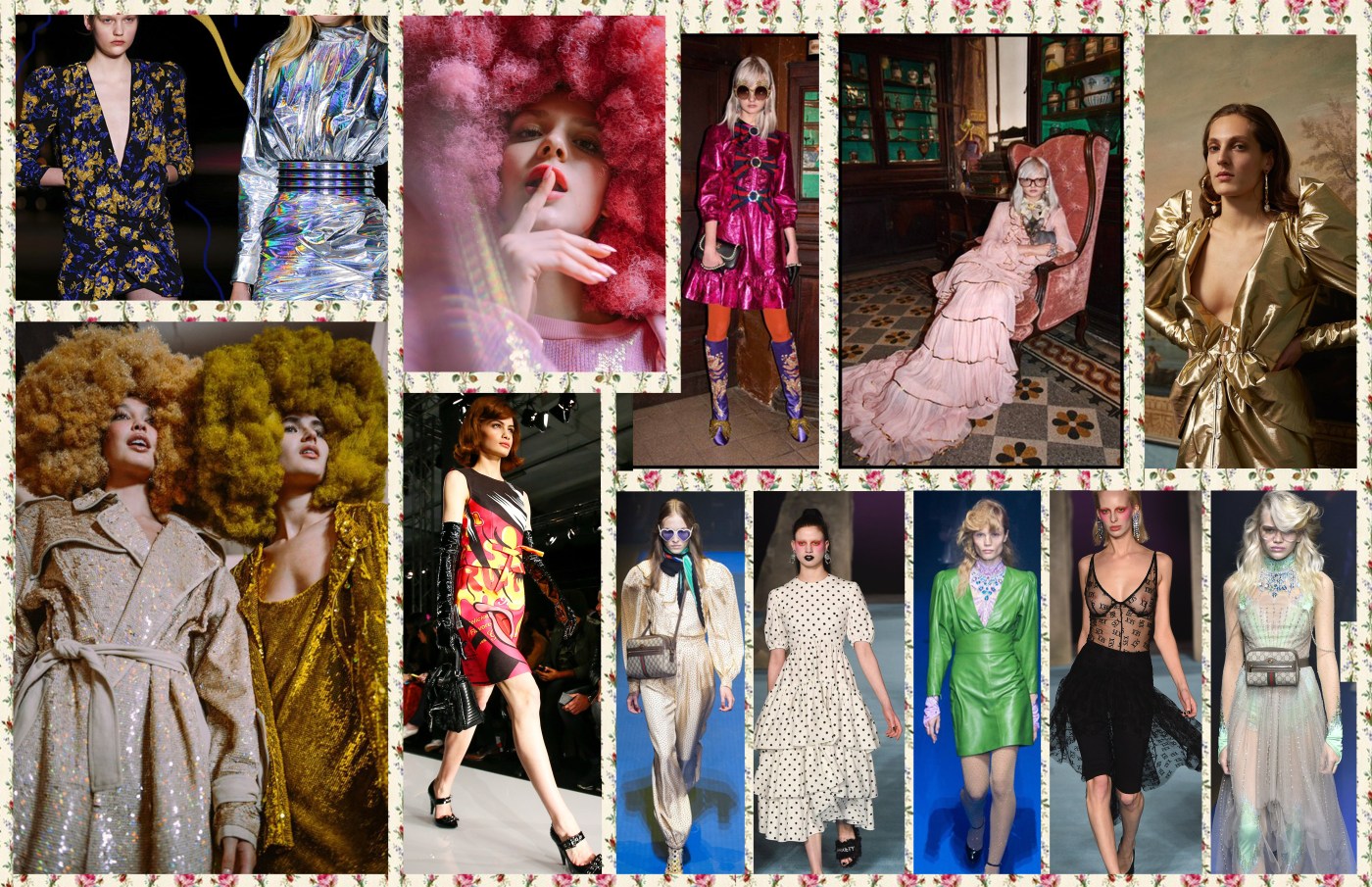
Fashion Idea Board:
THE FIVE W’S OF FASHION SHOW PRODUCTION
Starling Fashion Events – Molten Lava
There are five W’s for planning a fashion show. “Who, what, where, when, and why” (Everett 63).
Who (Client): Molten Lava, a new, small specialty store that carries private-label designer clothing intended for special events and evenings out.
Who (Audience): The target age range for Molten Lava’s consumer is twenty-five to forty years old, college educated, with an income of $50,000 and above. Their spending habits include buying items to look stylish for mixing, mingling, and entertaining. They follow trends; buy seasonally; are eco-friendly; and want to look their absolute best when going out for social evenings and special events. They are interested in “dress-up clothing” that can be worn more than once. The apparel presented during the Molten Lava fashion show will be of specific interest to the customer, while not appearing to be too expensive nor inexpensive; in which case, guests could feel embarrassed that they cannot afford purchases or overlook the merchandise completely as “non-status items.” The items for the show will be carefully selected to match the audience’s preferences and to promote appropriate trends. (69-72)
What: Molten Lava Fashion Show
Where: Lower Manhattan, New York, New York.
When: Mid-May of 2019. The Fashion Calendar will be consulted for exact date availability.
Season Featured: Fall/Winter 2019-2020 Ready-To-Wear Collections
According to retail calendars, fall merchandise is sold in stores as early as June. Because we are highlighting Molten Lava’s Fall/Winter 2019 Ready-To-Wear Collections, the fashion show will take place in mid-May of 2019. However, the collections will also combine “seasonless” garments alongside fall/winter wear to appeal to the broad audience.
“The seasonless dresser—one who reaches for velvet, lamé, and silk, rendered in vivid colors and moody shades alike, regardless of the temperature outside. The philosophy: instead of limiting [wardrobes] to pastels in spring, brights in summer, and vampy shades in winter,” wearers choose “any palette, no matter the season. Ditto for fabrics…stacking a mix of textures, finishes, and palettes in fabric weights that can be worn year-round, with the aim of offering clothing that won’t look tired after a few months” (Stalder). Keen for Molten Lava’s consumer wishes.
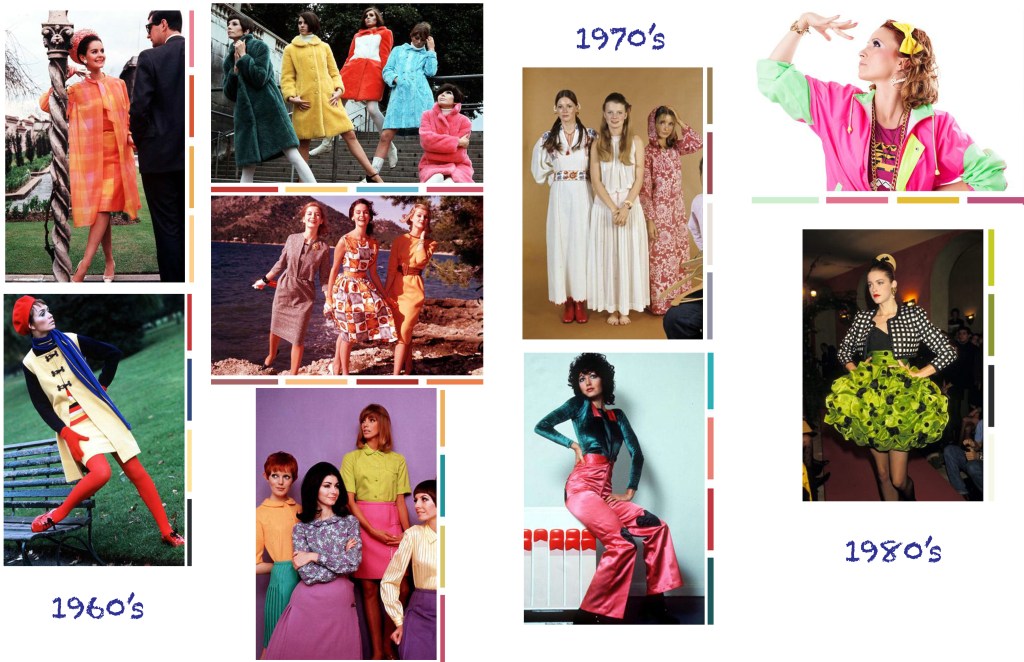
Why: The main objective of this consumer-oriented fashion show is to launch and highlight several of Molten Lava designer’s collections and give spectators a glimpse of the upcoming fall/winter 2019-2020 ready-to-wear collections that will soon be sold in-store. The goal is to also create buzz about, and motive purchases of the store’s merchandise selections. The runway show will highlight Molten Lava’s featured designers. The total length of the fashion show itself will be 30 minutes, and will display three, nine-minute scenes, each emphasizing a specific fashion decade from the 60s, ‘70s, and ‘80s. Thirty-six looks (twelve for each scene) will be sent stomping down the runway. Each look will be scheduled to be on stage for 45 seconds. (27 minutes), allowing three minutes for the opening introduction and runway finale. (60-64) Because our guests are fashion-forward, trend-seekers, they can view more looks in a shorter period of time, while also absorbing added style trends. The timing of the show is set to keep the audiences’ interest and give them a taste of what Molten Lava has to offer. The more designers and looks spotlighted, the greater number of consumers reached. (73)
The entire fashion show event will last approximately and two hours. This designates time for guests to arrive and check-in; have a sociable “cocktail hour” to mix and mingle; for the fashion show to take place; and for “photo-ops” following the show.
THE FASHION SHOW THEME
Theme: Retro Trend Revival: Transporting the Crazes of Yesterday, Today.
Name of Event: Fad Fascination
Showcasing the latest fashion trends, truly updated classics, from the 60s, 70s, and 80s— revitalized! Dedicated to urbane, stylish, trend-driven fashionistas in a refined and elegant atmosphere. This is a can’t-miss experience complete with upbeat music, undeniable beauty, and of course, style. (UBM Fashion)
Fun, fresh, and vibrant styles:
- Broad Shoulders
- Metallic/Silver Fabrics
- Silk
- Sequins
- Statement Sleeves
- Statement Bows
- Gold Lamé – Shine
- Transparent
THE MAKEUP
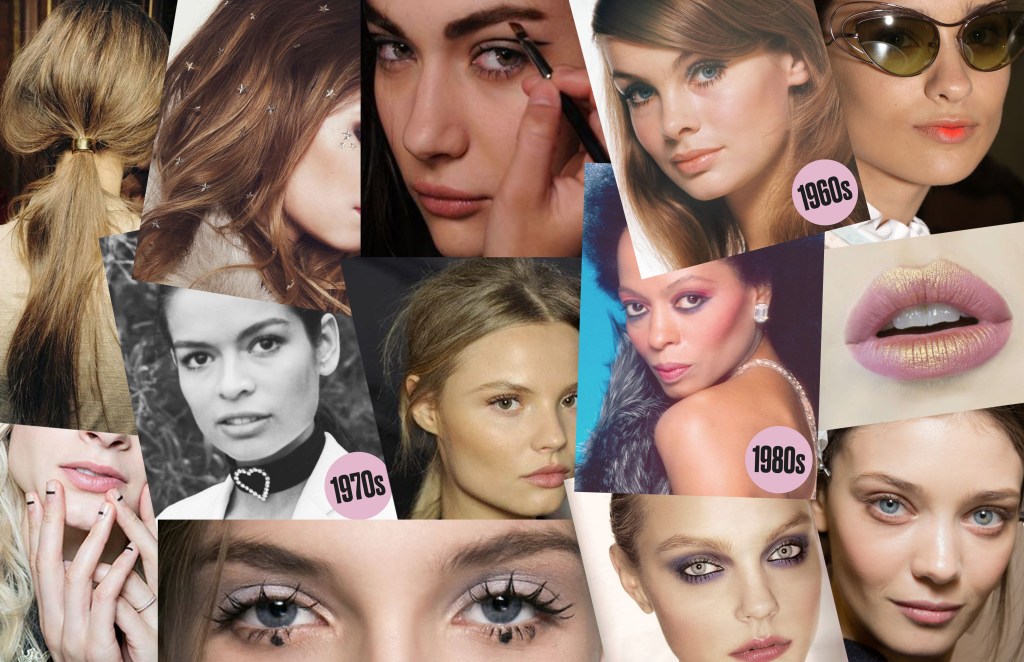
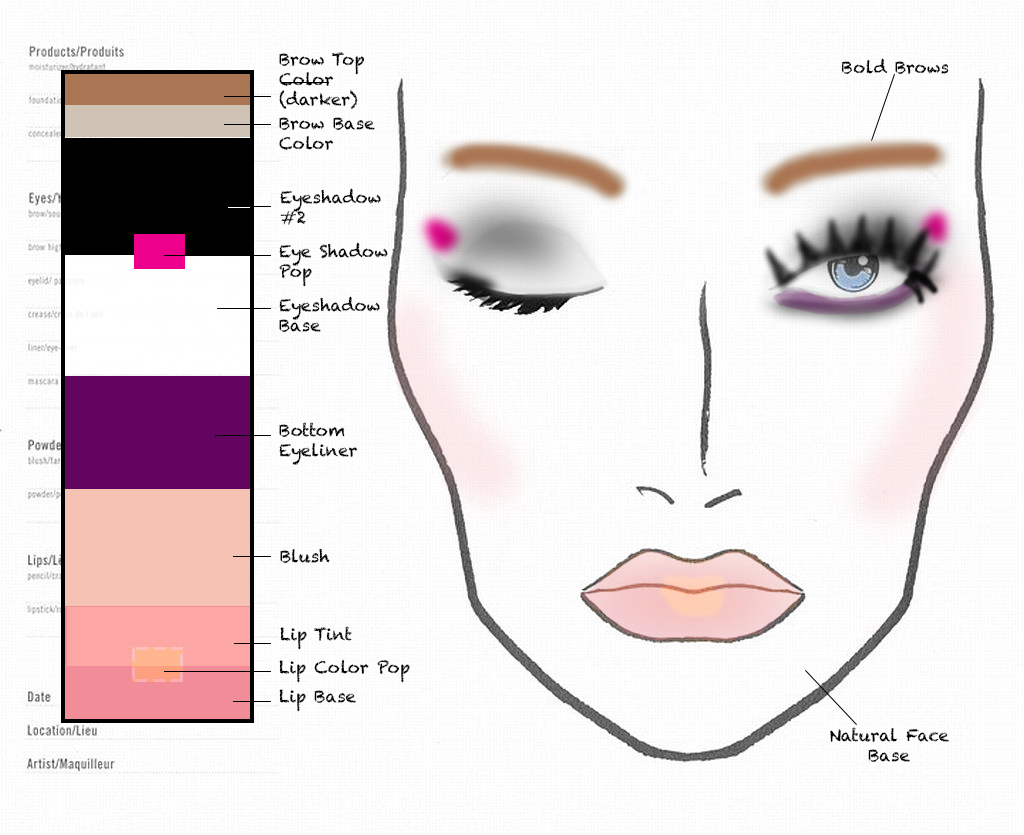
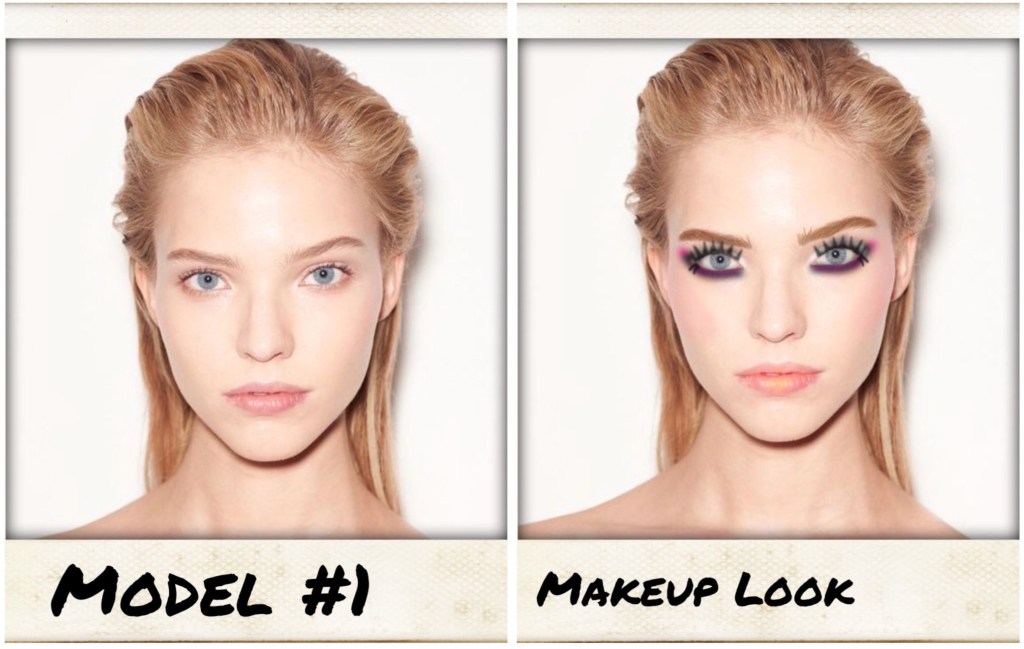
“After the show theme is established, the hair and makeup personnel start working on enhancing the image to be portrayed by the models” (Everett 197). The beauty image for the fashion show is alike “the icing on the cake.” A defined look has been chosen from the makeup, to the hairstyle, to the nails that will tie in to and communicate the theme/vision planned for the Molten Lava fashion show and each decade the theme encompasses, while also complementing the designers’ creations. This look will also be appropriate for each garment the models will wear. (Week 3 Lecture)
In order to bring out the best of each of the decades pinpointed for the Retro Trend Revival themed fashion show, a little bit of an aura from ‘60s, ‘70s, and ‘80s makeup trends has been applied to the beauty look for the show. An evening look has also been selected in order to communicate the “after five” date attire, evening wear, and special occasion merchandise that the client offers
HAIR: Long, Messy, Bumped-Up Low-Slung Ponytail with Center Part
’70s beauty has been revisited as the motivation behind the hairstyle for the fashion show. A low ponytail is versatile, making it perfect for any occasion, and particularly ideal for the fashions that the client offers. Think Ali MacGraw, circa Love Story, with her glossy blowout neatly divided down the middle and bound into low-slung style. It is a laid-back look, yet offers a striking dose of polish, the type of sophistication that combines easily with the Molten Lava apparel and consumer audience. (Schulte-Hillen 2015) The hairstyle will have a front center part leading into the crown where the hair will be teased or “bumped-up” in order to produce volume and accentuate the messy style, while adding a little bombshell to this evening look. (InStyle.com)
Center parts are beneficial, as they can also take on a variety of looks when paired with different hair textures. Extensions will be added to models with shorter haircuts. (Moorhouse 2015) “‘The revival of ’70s beauty brings us back to a time when life was effortless,’ says Butterfly Studio Stylist Jill Engelson. ‘Hair was more flowy, and natural—think air-dried—and overall style gave off a ‘lived-in’ vibe’” (Moorhouse 2015). To bring this hairstyle to the next level, a trail of small star hair gems will be scattered throughout the messy locks for a creative twist, fashioning “hair that would make a ‘70s-era Stevie Nicks proud” (Stalder 2016).
More specifically, and as displayed on the idea board, the back of the hair will be left long, and swept into a low, messy ponytail with a simple gold hairband accessory at the base. The crown of the hair will be teased, or “bumped-up” for more of a Disco/evening feel. The front of the hair will be divided into a cool centered part, and small star hair gems will be scattered throughout the hairstyle as shown.
MAKEUP:
FACE: Au Naturel
The earthly beauty from the ‘70s also serves as inspiration for the fresh-faced look for the show. Many women during the 1970’s opted for a natural look, they wanted their makeup to appear simple and effortless. The face will have a “barely there” undertone similar to that of what a young Bianca Jagger sports in the idea board photograph. A sheer foundation matching the color of models’ skin will be used, with natural peaches and pinks applications on the apples of the cheeks, resembling the photo on the bottom right corner of the idea board. The application will be kept light to look natural. (Hernandez 2015)
LIPS: Pastel Lip Pop
Artistic effects with dual-tone lips, as was seen in the ‘60s, will be put to good use by
using a pale, subdued matte shade of base lipstick, with an added pop of shimmery gold/neo-
orange pigment will be applied on the center-lip similar to what is shown on the far middle to top
right of the idea board. A little nod to the Pop Art era.
EYES: Loads of Lashes, Black and Purple Sultry Smokey Eyeshadow, and a Pop of Pink Wings
The look for the eyes has been inspired primarily by the makeup trends of the 1960’s and 1980’s. The idea board displays two ever-so-famous “it girls,” from the ‘60’s and ’80s, Jean Shrimpton and Diana Ross, who have served somewhat as muses for this look. Jean Shrimpton’s luxurious lashes and Diana Ross with boldly beautiful pink and purple eye makeup. “During the ‘60s, women adopted the wide-and-bright-eyed effect, characterized by extra-long false lashes along the upper and lower lids and tons of black mascara. To really rock the mod look, over-the- top lashes were often paired with colored shadow—white was a favorite hue”. Likewise, makeup of the 1980’s was considered: the more the better. A decade where “excess returned, and with disco music, and star-studded clubs like Studio 54 celebrating eccentricity and hedonism, women began to go for it with their eye makeup. Consider: M.A.C Cosmetics was born in 1984 to answer the needs of two Canadian makeup artists who wanted bolder, more highly pigmented colors that would photograph well. Vibrant pinks, purples, and shimmery golds were worn alone or all at once for a for serious impact.” Both decades practically dictate the vision behind this runway look. (Bowen 2016).
The eye makeup includes long, thick, black lashes (false lashes will be applied), with loads of mascara to achieve this look. A similar false lash will be put on the bottoms of the eyes with only two long lashes (adding a dramatic effect), and white eyeshadow will be applied on the base of the eye for that ‘60s wide-eyed look. Black eye shadow will be used at the crease of and underneath the eyes, smearing up into a “smokey-eye” effect. Taking another note from Jean Shrimpton’s larger-than-life doe eyes, and mimicking her iconic purple eye shadow, purple liner will be applied under the eyes, while a pop of pink wings turns this look into a late ‘60s-inspired smudged cat-eye made up of the effervescent colors prevalent of the ‘80s. (Moorhouse 2015). A deep smoky eye never goes out of style. It has a strong, intense, and dramatic effect, fits with all skin tones and goes well with evening wear apparel. The white eyeshadow with thick lashes and purple smoky eye is also portrayed on the bottom-center of the idea board. (Week 3 Lecture)
BROWS: Bold Brows
Reasoning for the dark and full brows spurs from the ‘60s with “the Hepburn effect,” which was sparked by the star’s thick, natural set, inspiring the women of the ’60s to fill in their own with well-placed strokes of the brow pencil. Correspondingly, thanks to stars like Brooke Shields, who also flawlessly worked a full brow set, the women of the ’80s got their grow on, with ample brows completing any good power-dressing ensemble and relaying the sophistication that Molten Lava embodies. (Mychaskiw 2015) As pictured in the top-center of the idea board, the brows will be bold and filled in with dark shadow and brow pencils.
NAILS: Cubism Comeback
The nails are aimed towards minimalism, a very sixties, Mondrian-esque Yves Saint Laurent dress-like approach. Simple black squares (similar to the nails exhibited on the idea board) will be applied to the tops of each model’s nails in various arrangements.
MODEL SELECTION:
Models are essential to the image and execution of the fashion show. They must be able to effectively promote the appearance of the clothing and communicate the appreciation of the look or theme of the garments to the audience authentically. Audiences can be inspired sartorially after watching and imitating fashion models; therefore, an appropriate model selection is key to the show’s success. (170)
During castings, models must arrive well-presented and groomed with good hair and skin. Their figures should be well-proportioned and fit as closely to sample sizes as possible, since alterations are expensive and time consuming. Model Coordinator Drew Baxter should select and book models that are eye-catching and edgy, but not necessarily gorgeous. The audience should enjoy their appearance, but their look must not deter from the merchandise being presented. Favorably, model picks will have a flair for fashion and an instinct about how clothing and accessories should be worn, as well as the ability to exercise their fashion sense and enthusiasm in showing Molten Lava clothing at its finest. Chosen models must project a professional attitude, including cooperativeness with all fashion show staff and other models, and show respect for the clothing. They must also be able to keep their composure when and if mistakes or unexpected incidents occur and be able to cover up such episodes gracefully. (171- 172)
The castings will call for editorial, petite, and runway models. Because this is a specialty fashion show a wider range of models will be featured in order to properly portray the variety of the retailer’s apparel. Editorial models have experience working the runways during fashion week shows held in the major fashion capitals of the world. They have very slim figures, range from sizes 00 to 4, and are typically between 5 feet 9 inches and 6 feet in height. “The audience for editorial models tends to be fashion insiders with interest in being fashion forward by predicting fashion trends, influencing the mass market, and defining brand credibility,” which incorporates the Molten Lava target market. Petite models range in height from “5 feet 2 inches and 5 feet 7 inches tall. Many designers offer clothing in petite sizes; therefore, most petite models work for specialty fashion shows featuring petite sizes. Working runway models encompass the style, poise, and confidence to present clothes on the runway, as well as the ability to connect with the audience and photographers to promote the clothes they are wearing.”
A few choice amateur models may be employed if the client feels that it would be appropriate for the show, and/or if Jenny has designated amateur models she would like to use, as in family or friends. These types of models “have a great drawing power,” since “audiences love to see their friends and relatives participating in fashion shows” adding to their enjoyment. Select amateur models could also contribute to the “believability factor.” Spectators appreciate viewing garments on “real people,” because they see themselves wearing the clothes. This tactic may also further encourage purchases. (172-177, 188)A signed personal responsibility contract will be implemented by Drew Baxter to encourage professional participation from the models. Models will be given the dates for each practice, the dress rehearsal, and the show upon their selection, and each will be asked to make a commitment to participate in each of these sessions. Practices (and make-up practices) will take place at regularly scheduled times once each week for about five weeks before the week of the show. The model committee will spend the first couple of practices teaching models (the amateur models in particular) how to walk, turn, and pose on a floor outlined with masking tape to the dimensions of the runway that was to be used for the show. Model release forms will be signed to allow show producers to use the models’ images in a video, as well as in other promotional and print media. Twenty-one models will be selected in all, three of those being alternatives, for a total of thirty-six runway looks, or two looks per model, for the thirty-minute runway show. After the models have been selected, the model committee will prepare a formal model list including each model’s name, telephone number, e-mail address, garment size, and shoe size. Members of the model and merchandise committees will find this information essential. (189- 194)
CLOTHING OPTIONS:
Several factors must be considered when selecting merchandise. Because a chief objective of this fashion show production is to sell clothing, selected merchandise must make a clear fashion statement to the audience to stimulate after-show sales. The merchandise should be suitable to the demographic profile and lifestyle of the audience and priced appropriately to what they will spend on fashion. The merchandise must have strong stage presence for everyone in the audience. The consumer-based show will display merchandise from Molten Lava, highlighting the featured designers and seasonal trends. (150-151)
Merchandise within categories should be grouped in a pleasing manner indicating a rhythm or flow among looks. In this case, the pieces will be categorized into three groups or scenes, according to the identifiable decade intended by the theme. The merchandise flow is critical to an exciting presentation. Effective merchandise flow allows the audience to visualize how garments may be worn together. Coordinated pieces should be shown in succession; therefore, scene one will show trends from the 1960’s, scene two will highlight trends from the 1970’s, and scene three will emphasize trends from the 1980’s. (152)
Type of Merchandise: “After 5”/Date/Cocktail Attire, Evening Wear and Special Occasion Fashions
The clothing options for the show will be predominantly black and white, with pops of color and prints. Blacks and whites are signature colors for evening and special occasion wear, and they also emphasize the sophisticated, tasteful nature of the Molten Lava merchandise and consumer market. This approach is also resourceful in that the beauty image will translate well with a similar color palette throughout each look.
Scene One—The Mod Thing
Pure Pop
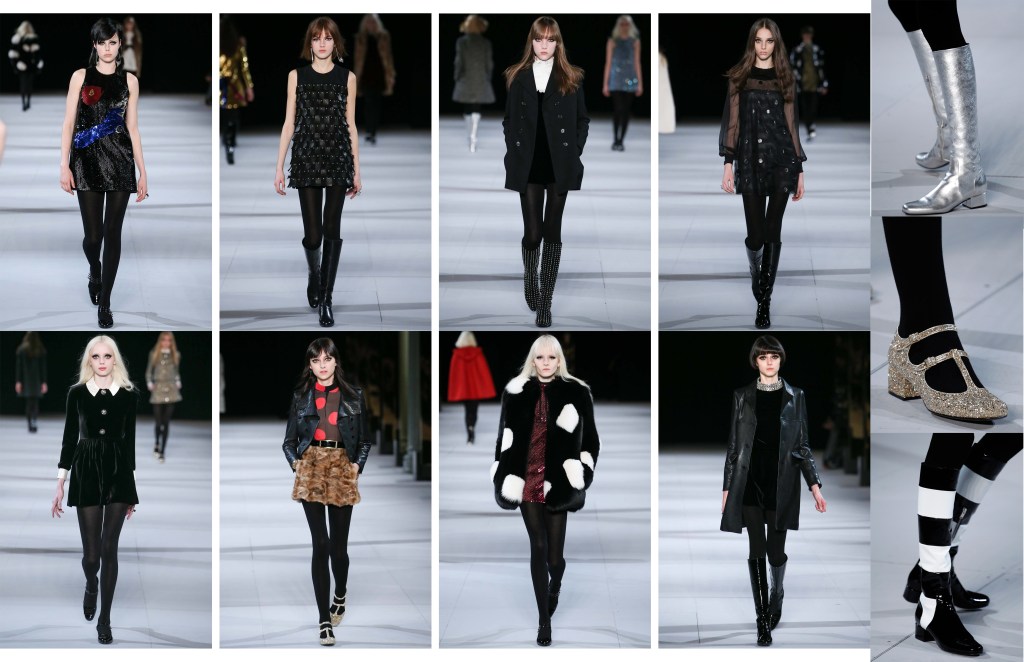
During the early ‘60s, women wore either skirts or dresses for just about everything. As the decade went on, skirts became shorter and collars on dresses widened. Large, bold flowers and bright colors eventually became popular in fashion during the 60s. Seersucker and silk were often the fabrics that were worn. During the late 60s, miniskirts became popular, followed by extra confidence instilled in women. The stilettos that once were popular during the ‘50s were traded in for low kitten heels and chiseled toes. (Pietroluongo)
The Saint Laurent Fall 2014 Ready-To-Wear collection was a real pop show. The models were perfect, sparkly, leggy complements to the lair-y likes of Turner and Kane, but their outfits also distilled the mid-sixties moment when pop was purest—and when Yves himself was designing his own edgy responses to the tremors of London’s youth-quake… the appeal of pure pop that is timelessly potent. Capes were significant, but so were glittery little dolly bird shift dresses. There were at least a dozen extremely desirable coats. The casual extravagance (extravagant casualness?) of Slimane’s vision was best captured by Edie Campbell in a fur- trimmed army parka over a lamé top, black tights, and crystal-covered Mary Janes. Between the name and the look, it was hard to miss the spirit of Warhol’s Edie, the ultimate pop princess. Translating poignantly to the Molten Lava merchandise and the consumer audience. (Blanks 2014)
Scene Two—Seventies Revival
Studio 54, Disco Vibe
The 1970s are one of the most revisited decades when it comes to fashion trends, and the decade still to influences modern style today. The decade encapsulates various iconic styles, and endless creativity, yet there was a complete absence of style rules and standards. Still, the seventies style is much appreciated for it became a means of expressing the individuality of a person, her unique vision of style and creativity.
Because the ‘70s were so diverse, for this fashion show trends will be focused around on ‘70s disco glam fashions, as it coordinates well with the type of merchandise in addition to the consumer audience. (Brewer, Fashionisers)
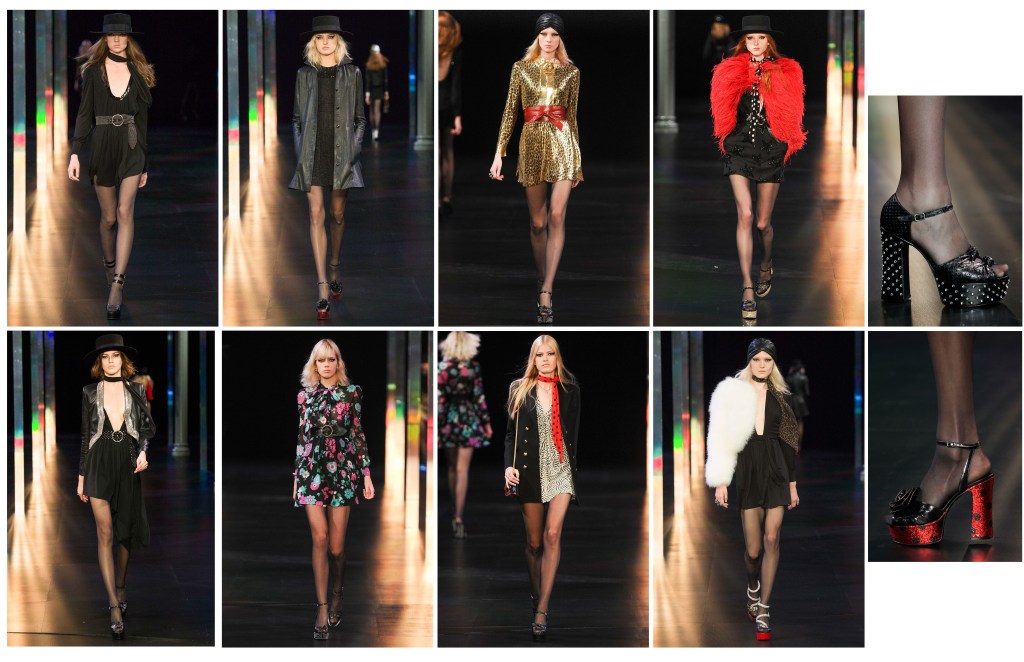
The Saint Laurent Spring 2015 Ready-To-Wear collection embodies ‘70s disco glam perfectly: with metallic golds, sequined mini dresses, turbans, thin scarves, leopard prints minidresses, platform sandals, floral dresses, studded belts and (faux) fur “chubbies” tossed carelessly over a shoulder. “Shake a leg in funky platforms. The chunky shoes set off slinky disco dresses and make legs look a mile long. Skinny scarves also made a comeback, tossed nonchalantly around the neck, along with Marisa Berenson-style turbans that are perfect for bad hair days. And when in doubt, belt your outfit” (Aktar & Masters 2015).
Scene Three—Totally Eighties
Eighties Party Girls, From the Closet of Debbie Harry to Madonna!
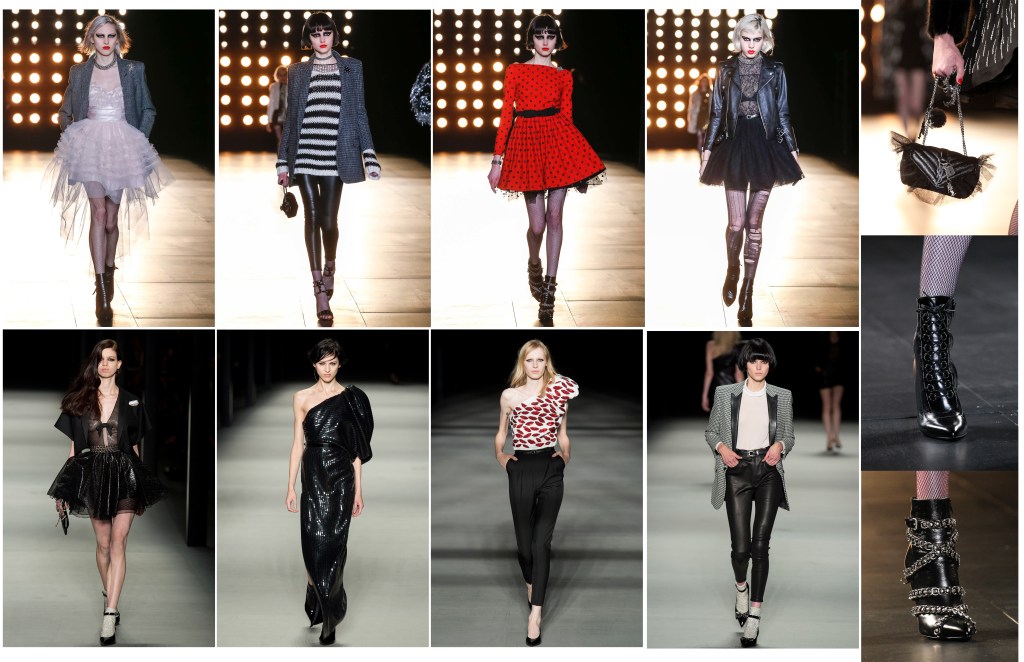
With the advent of MTV in the 1980s, style and fashion was greatly influenced. The music industry set the tone for what society would wear and how they would style their hair and makeup. Expression of individuality and creativity was important to people. (Pietroluongo) Hedi Slimane was in full rock and roll mode for the Saint Laurent Spring/Summer 2014 and Fall/Winter 2015 Ready-To-Wear collections, representing Eighties party girls at their finest, wearing “any number of retro sexpot dresses.” The collection’s purposes were to entice with the familiar including all things Eighties: polka dots, see-through layers, miniskirts, hosiery and socks, sharp tailoring, leggings, sequins and structured shoulders. (WWD) Think of the outrageously trendy styles of Blondie, Tina Tuner, Cyndi Lauper, or Madonna.
THE VENUE
Location, location, location!
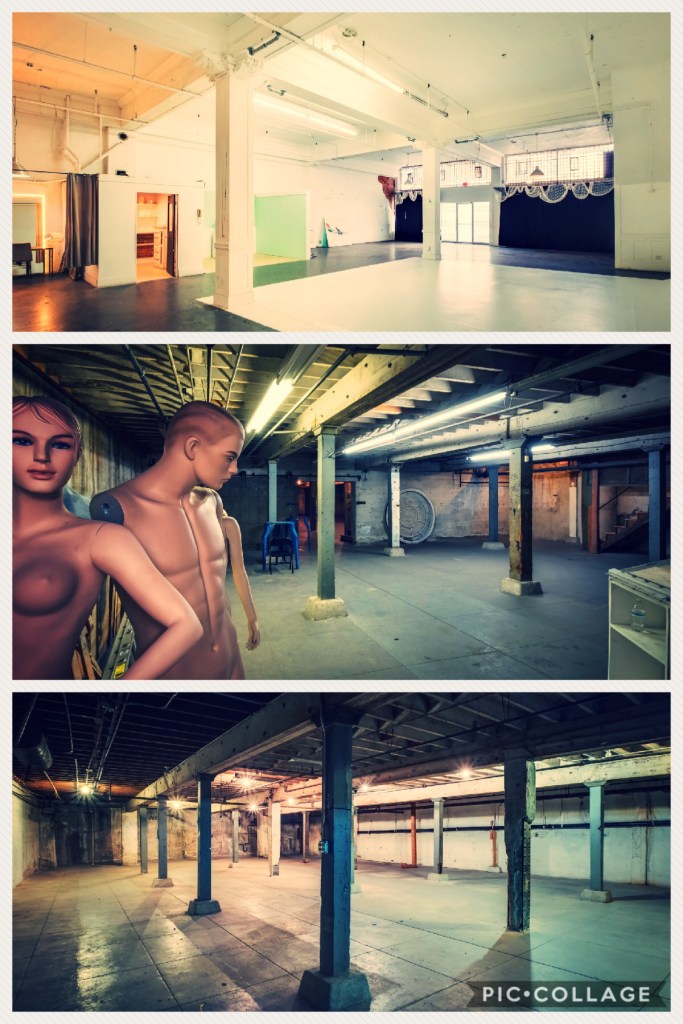
The site chosen for the fashion show is located in Lower Manhattan, New York, New York. The listing is entitled, “An Utterly Unique Space for Parties, Fashion & Film in East Village,” and is described as a chic studio venue that is easily reimagined to suit the event and its vision. The venue promises to deliver “an entirely unique experience for guests and/or attendees” (Peerspace). The location is easily reachable via nearby public transportation, has on street parking, street level access and is wheelchair accessible including ramps to accommodate easy load-in and load-out. (Week 4 Lecture) The lease rate is $475/hour
The space will be rented for six to eight hours allowing time to set up/construct the facility, complete preparations for the show, rehearsal, the event itself, breaking down structures, and cleaning-up. Clean-up will be assisted by venue employees. (82) Yet, if the time limit meets or exceeds eight hours, which is likely, a twenty-percent discount will be applied to the rate.
The layout of the 13,000 square foot venue permits a flexible floor plan for preferred seating arrangements. A combined floor plan will be employed to accommodate seated guests as well as standing. This event is aimed for a more intimate setting and will expect 250 attendees total. Seventy-five seats will be reserved, lined along each side of the runway platform, in theater-style seated arrangement, for traditional and digital media representatives, influential customers, and friends of the designers. (69) The standing room will be open for the one-hundred and seventy-five remaining guests. All members of the audience will be able to easily view the fashions from a comfortable location. (70)
There is an open vendor policy, and beverages will be supplied through a local vendor. A contract will be prepared to protect both the vendor and the fashion show producers, explaining what will be served, the costs, and any other vendor obligations. (78) Catering supplies and chairs are offered directly through the venue. The rooftop of the site provides a lovely overlook of New York City. This area will be open before and after the show where guests can network and socialize. The site has strong white walls, so freedom for support materials on the walls or ceilings have been approved. An initial stage is offered by the venue, which will be applied as the beginning of the runway. Platform extensions and risers comparable in height will be attached to lengthen the stage area for a raised runway setup. A private room is available for dressing rooms, hair and makeup, wardrobe changes, etc. There is also a kitchen facility with restrooms that could easily be used for additional dressing room space. Wardrobe racks are provided in-house as well as blackout curtains that could be employed to mark off a larger backstage area or storage space if needed, or for the upper A/V area for a clean look.
Ample electrical amenities are offered that will be utilized during the show’s production, such as a state-of-the-art A/V system available in-house and operated by an on-site attentive technician, dedicated to executing the event’s vision. (Peerspace)
Others include:
- Speakers
- Microphones
- DJ Booth
- WiFi
- Photo & Video Equipment
- Projector
- Green Screen
- Lights
Additional internal facilities and services include restrooms and security.
**Note: Although this is an actual venue, some details have been changed to meet specific requirements.
THE VENUE THEME
Old Hollywood Glam (i.e. 1930s Hollywood Regency)
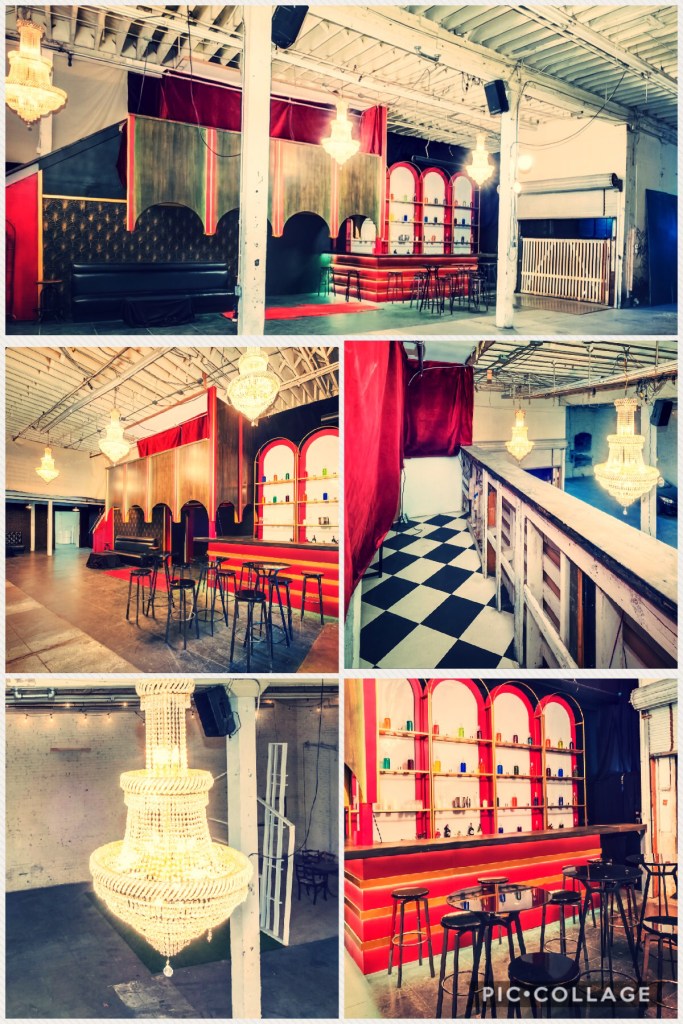
The theme creates the ambiance, the heart of our event. It is what will make this show memorable, stimulate the production style, music, fashion and every other fine detail. Idealistically, an Old Hollywood Glam concept will complement the chic merchandise of our clients, while guests/consumers have an excuse to wear their fieriest outfits as they step onto our “walk-of-fame” red-carpet entrance.
This theme will also present ample potential for staging as it can employ either maximalist or minimalist décor. That is the beauty of working with interiors with an Old Hollywood Glam theme, both ends of the spectrum will work. This Glam proposal will present an ultra-elegant radiance, whether we choose to use luxe high-end pieces dripping with crystals, wildly eccentric champagne fountains, and paparazzi entertainers or not. (Ness 2014)
On the other hand, sometimes less is more. The focal point of the fashion show itself, could be anchored solely by an enormous chandelier that hangs in the center of the square-shaped runway with sleek black- and-white flooring, keeping the design from
being too chintzy, and conceivably appeal to a broader audience (young to more mature). (Sekula 2013) It is a collectively popular theme that highlights the sophistication of the merchandise selection, while sparking intrigue appropriate to draw in our target audience.
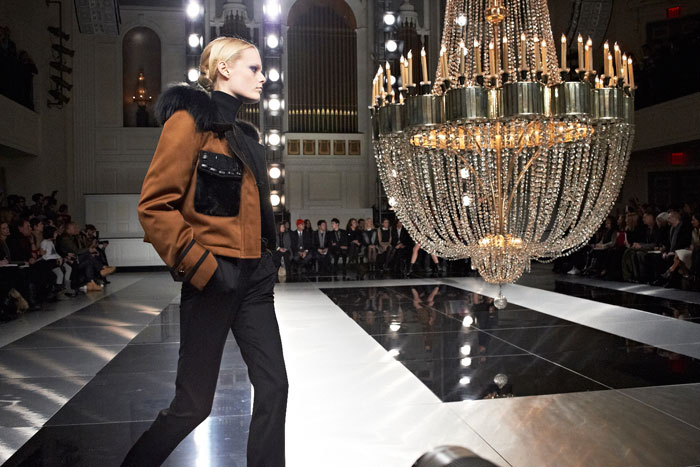
Jason Wu F/W 2013-14 RTW Photo Courtesy of Bureau Betak (Sekula 2013)
The show venue is every bit as important as the merchandise selections to the statement our clients want to make. It is a prime opportunity for Starling Fashion Events, Molten Lava, and Elegenza Accessories to flex our creative muscles and stand out from the crowd. (Wallpaper*) By commandeering a site that is typically “off limits to mere mortals,” and creating special installations, we will transform an otherwise disused space with spectacular results. No detail will be overlooked. (Byng 2010) The art-deco bar and its design elements speak for themselves in reference to the Old Hollywood Glam theme, and it will be easily brought to life through our staging, dressing, production, and urbane Molten Lava fashions alongside Elegenza’s new statement bag. A red-
carpet entrance, complete with photographers, paparazzo and all, will underscore the theme and give both the men and women attending a chance to strut their evening wear and have photo-ops. Truly fun for everyone involved.
Hollywood glam, aka 1930s Hollywood Regency, celebrates all the glitz and sequins one can muster. It is posh, elaborate, yet refined. Black-and-white glamour shots of Marilyn Monroe, Sophia Loran, Audrey Hepburn, and those alike in gilded frames throughout the site would provide a graceful way to wink at the “old greats,” and/or framed vintage Vogue covers would complement the setting nicely. (Ness 2014) A bit of humor and Old Hollywood nostalgia mixed with “an explosion of unabashed glamour and glitter” (Elle UK). Vanity mirrors, and other props from the Regency Hollywood era placed intricately throughout the space would create a Glam atmosphere. Chandeliers, champagne filled flutes, popcorn bars, cascading lights, velvet ropes, vintage film reels, strategically placed diamonds and strands of pearls are only the beginning of other inspiration/ideas for staging to heighten the ambiance.
THE STAFF
The principal members of the fashion show event’s pre- and production staff include the designers and fashion director from Molten Lava, the show producer (or hired coordinator from Starling Fashion Events), and the stylist.
The fashion director will be responsible for creating the fashion image for Molten Lava. Together with the store’s buyers, they are responsible for selecting silhouettes, colors, and fabrics for the upcoming season and establishing a sense of fashion leadership for the store to present for the show. They are responsible for planning all arrangements, delegating responsibilities, and accepting accountability for all details. (65)
The show producer is in charge of the staff, taking the initial plans and bringing all of the fashion show elements together to translate the original vision into a three-dimensional live show. Their responsibilities for the show include: casting the models, overseeing the design and construction of the set, supervising hair and makeup artists, and directing the lighting and music crews. They will know what helps or hinders the fashion media and hire photographers and a video crew for services before and during the show. The show producer, designers and stylist will jointly decide which models will wear what outfits. By choosing the best models to wear the most significant outfits, the interest from fashion editors can almost be guaranteed. (63-67)
The stylist will provide creative input to the designers and show producer, will be in charge of presenting clothes with an eye for upcoming trends. During the show the stylist is responsible for planning how to highlight key pieces of the collection through editing and accessorizing and supervises the apparel and dressers. The stylist understands the target audience and interprets the looks with attention to detail, appropriate model fit, and use of suitable accessories. They will also decide garment order and which individual garments are coordinated to form an outfit, strongly influencing the overall impact of the merchandise. These fine details will give the collection its feel, classy, sexy and formal. (64-65)
The show producer, fashion director and stylist will also act together, splitting the responsibilities of a merchandise coordinator. This involves selecting the merchandise for each scene and the entire show… picking clothing, accessories, and props to pull each segment of the show into a harmonized whole. They may also delegate merchandise selection responsibilities for specific scenes to other staff members. The stylist will also facilitate fittings prior to the rehearsal. (68)
Further members of the show’s staff are the models, dressers, makeup artists, hairdressers, and the entire behind-the-scenes stage crew. The crew working behind-the-scenes will largely be Molten Lava employees and volunteers.
There will be 18 models for the show, and each model will wear two looks. Timing for the dressers will be crucial as they will need immediate wardrobe changes the second they step off of the stage. There will be 25 dressers so that one to two at a time are able to tend to a model’s wardrobe change and ensure that all of the complete look is assembled correctly. The dressers will be part of the behind-the-scenes stage crew and will be made up of store employees and volunteers. There will be four makeup artists and four hairdressers that will “make-up” the models prior to the show and be available for touch ups during the show. A seamstress will also be on hand.
In total, there will be about 50-55 staff members needed to run the show. From designers, show producers, and the stylist to dressers, models, the DJ, lighting technicians, etc.
Fact Sheet and Action Plan
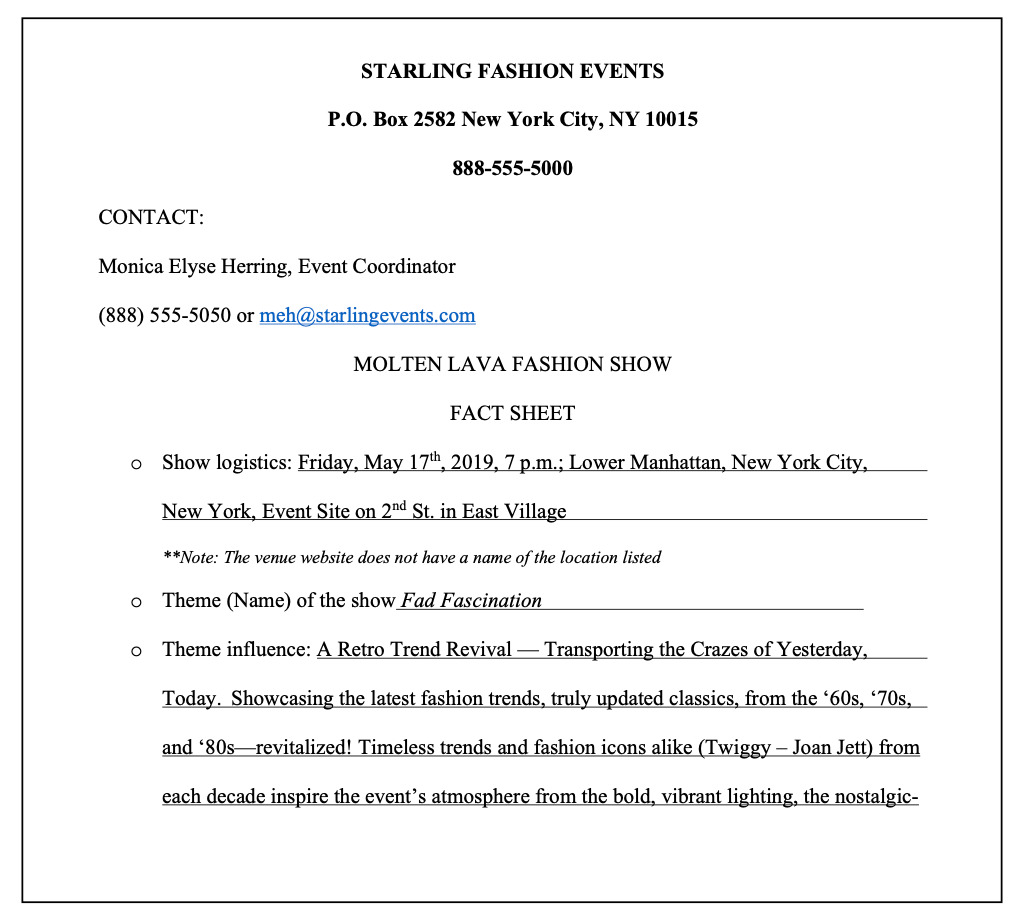
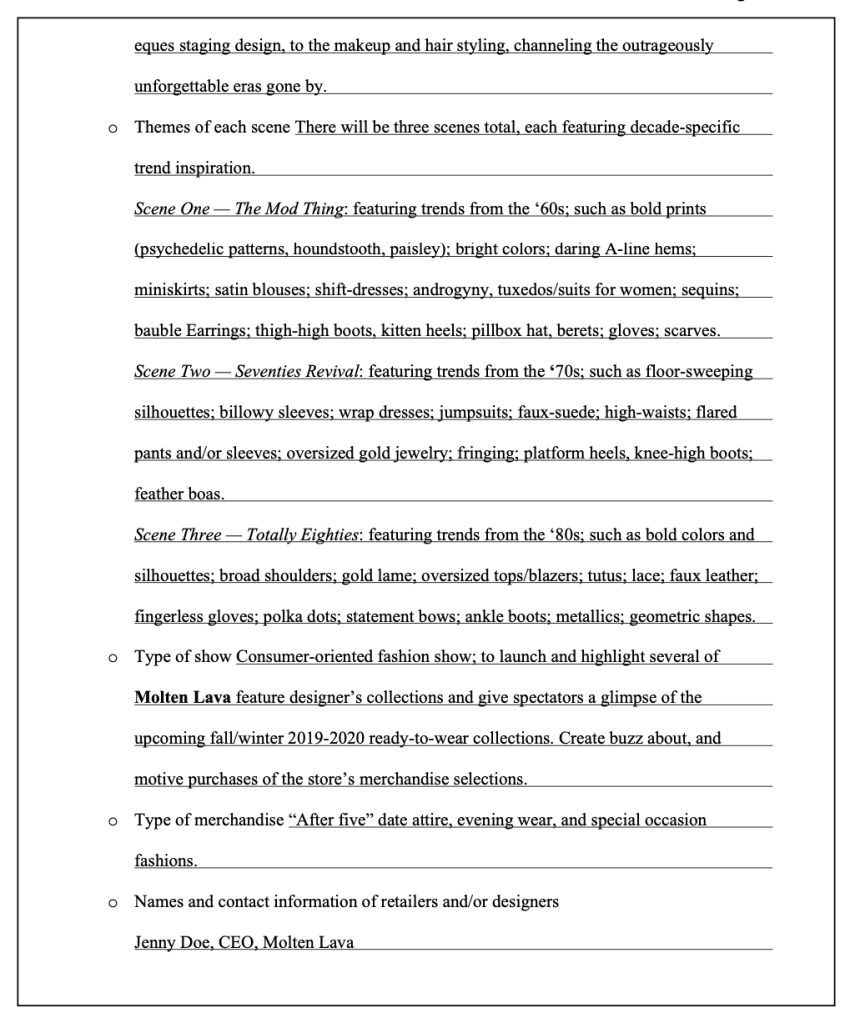
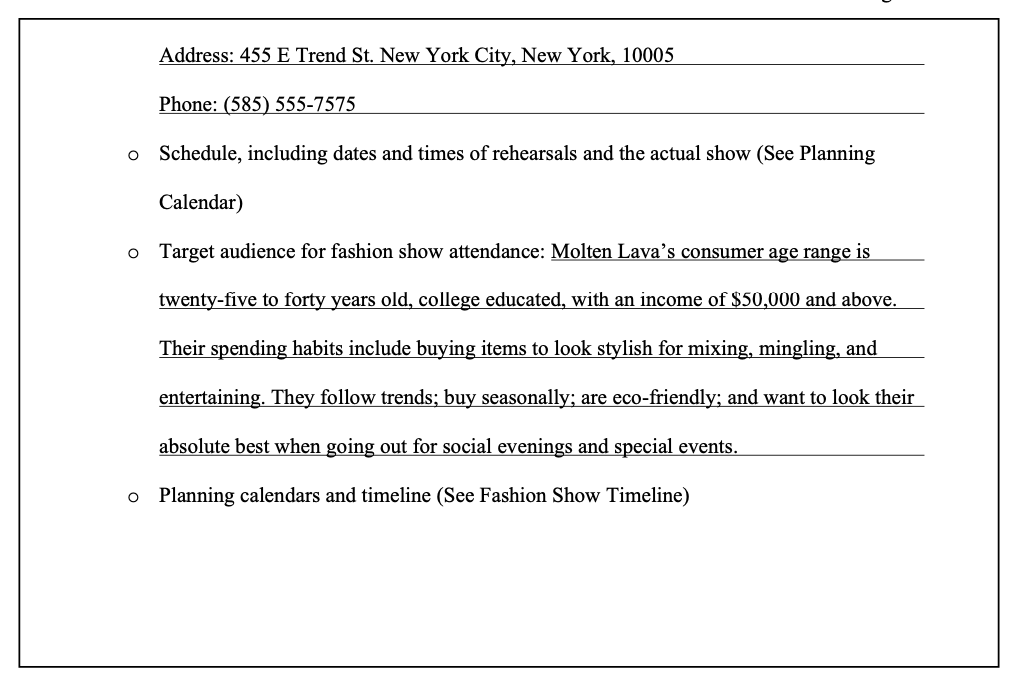
THE INVITATIONS/AUDIENCE
“Fashion involves change.” Because transformation is an asset of the fashion industry, fully embracing new communication technologies, including the Internet and social media, are some of the best ways to get noticed instantly. In order to reach “the always evolving fashion consumer,” promotional techniques must progress as well. Combining modern-day methods with traditional communication approaches, such as direct mailer invitations, would be the best way to reach a consumer market with wide-ranging ages. (Everett 104) For example, a more mature audience may not be as “tech-savvy” as subsequent generations. The Internet and ever evolving social media platforms have become a type of “generational trend,” as different age groups use them for different purposes.
However, this approach does not fully apply to the Molten Lava target audience, which consists of twenty-five to forty-year-olds and predominately incorporating Generation Y (Gen Y), or Millennials.
- “Gen Y, born between 1980 and 1994 and are currently between 24-38 years old.
- Gen Y.1 = 24-28 years old (31 million people in U.S.)
- Gen Y.2 = 28-38 (42 million peeps)” (Kasasa 2018)
In total, this generation makes up approximately 73 million people. Only a small portion of the Molten Lava target market would qualify as Generation X or the successive Generation Z. This becomes important in way of invitation distribution techniques, because of the differences in generational habits when using the Internet and social media. For instance, “more than nine- in-ten Millennials (92%) own smartphones, compared with 85% of Gen Xers (those who turn ages 38 to 53 this year), according to a new analysis of Pew Research Center data. Similarly, the vast majority of Millennials (85%) say they use social media. For instance, significantly larger shares of Millennials have adopted relatively new platforms such as Instagram and Snapchat than older generations have” (Jiang 2018).
Still, traditional (or direct mail) communication strategies would not be completely obligatory in creating publicity for and distributing invitations to the Molten Lava fashion show. “Millennials or Generation Y are heavy internet users. American [Gen Y] users had the highest monthly average of internet usage amongst all group ages in 2016. That year, online [Gen Y] users spent an average of 2,891 minutes online via PC per month. In the U.S., [Gen Y] internet users aged years spent 57 percent of their online minutes via smartphone apps, and eight percent via smartphone web” (Statista). These numbers of which have probably only grown since this data was recorded, and further communicate the fact that this fashion show could be successfully marketed through solely Internet and social media approaches.
“Haute couture and ready-to-wear industry-oriented shows are extravagant promotion tools used to get the media and potential customers excited about the fashion messages of the new season. Consumer show producers also depend on promotion efforts to assure an audience for their productions” (104).
The most important factor when considering the type of marketing tools to use for a fashion show is the audience. For example, if the show incorporates trendy and youth-oriented clothing, the audience will be young adults in the age group of seventeen to twenty-five years old, and the media used should be one that the target market will watch. Marketing tools also differ on the type of the show and more importantly, the show’s budget. For instance, when producing a charity fashion show, the charity organization itself will probably arrange for local television air time, radio spots, and newspaper coverage because these media channels and the press are typically willing to publicize charity-type events. Moreover, for charity events in particular, sponsors are more willing to underwrite many of the costs, including publicity and media advertising. (Week 4 Lecture)
On the contrary, when organizing a fashion show for a new designer or retailer, the budget may not allow for various expensive media outlet advertisements or publicity. In this case, more budget-oriented direct mailer invitations or promotional materials should be sent out in order to publicize the show. (Week 4 Lecture) In fact, one of the most common forms of advertising for a retail or consumer-oriented fashion show in comparison to haute couture or ready-to-wear shows is through local or regional newspapers. (108)
“Although fashion aims to be always forward thinking, these days of round-the-clock Tweets, Facebook updates, multiplatform strategies, and image-obsessed Instagrams make it hard for the fashion industry to keep up with the constant change in the social media world” (129). Even with the advent of social media, the graphic style should remain the same when it comes to marketing or sending invitations. As with print media, social media invitations should have three key aspects: they should be informative, easy to read, and short. Accordingly, the graphic design is an essential component to any marketing presentation. “It is best to adhere to basic, fundamental principles of good design,” for instance “maintaining a consistent color scheme,” but one where the logo stands out. (Kim 2017) Printed invitations can become costly, since they should be printed on high-quality paper, and present an elegant look. For this reason, direct mailer invitations should be sent to a specific, targeted guest list. (136) Again, the distribution style for event invitations should reflect the type of show, its budget, and the most efficient approach in reaching the directed audience.
THE SEATING ARRANGEMENT
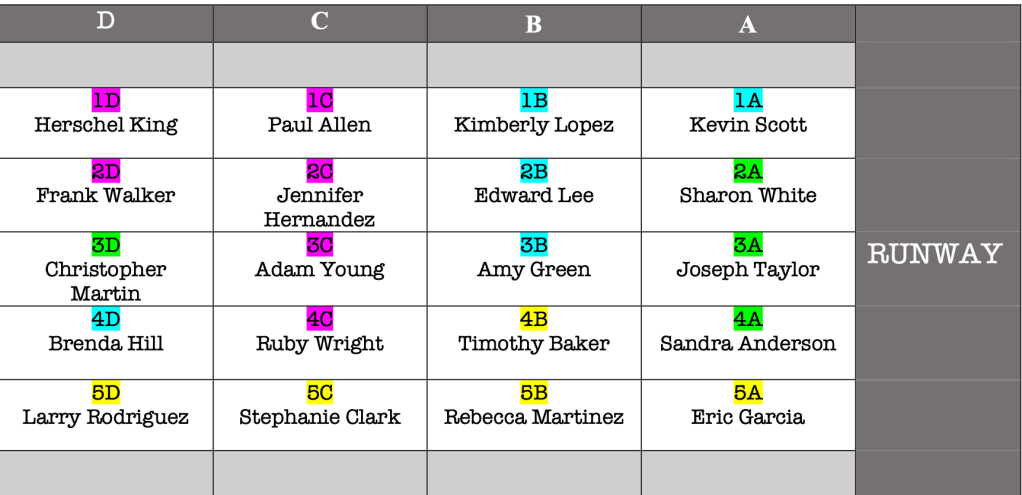
Theater style seating will be applied for the Molten Lava club event seating arrangement, which includes “placing chairs side by side and next to the runway.” This seating style “provides the best view of the fashions in the show because all the members of the audience are seated facing the runway” (223). A carefully thought-out seating chart has been produced to designate where the twenty guests for the show, including celebrities, press, retail buyers, and friends of the retailer or designers will be seated. The names of these guests will be placed accordingly on their seats at the show. (258)
THE GUEST LIST
As Sarah Young states in her article entitled Politics of the Front Row: PR Powerhouse Reveals the Rules of Fashion Show Seating, “In the fashion world…you are where you sit. And, while the catwalk may be perfectly choreographed, the seating arrangement of guests is just as, if not more, thought out.” The seating arrangement is considered by many in the fashion industry as a “statement of ranking.” One thing that is certain is that the more important a guest is, “the closer they will be to the action.” Young explains, “It’s a sartorial game of chess that requires an astute knowledge of the hierarchies of the fashion industry.” Co-founders Ash and Ella of Ella Dror PR describe, “‘[i]t’s important to have a balance across all the various industry areas at a show, there’s no point filling a front row with editors if there are no buyers there to buy it, and likewise, no point filling a show with buyers if there’s no media there to communicate it to the customer’” (The Independent 2017)
Ideally, for a seating arrangement involving twenty guests with a runway in the center of the venue, there would be two front rows on each side of the runway with ten chairs each; or even two rows of five seats on each side so that each guest feels like they are more involved with the show. Especially in terms of this type of guest list involving celebrities, buyers, press and friends of the designers, who would typically each expect a front-row seat.
Another way that the seating arrangement could be better established would be by knowing each guests exact affiliation and position within the company. For instance, when it comes to the five members of the press listed on the guest list, the Editor-In-Chief of say Vogue Magazine would be placed closer to the runway than someone more junior. (Bourne 2013) The same strategy would apply to the other categories of the guest list.
One approach that publicists use to “handle the many overwhelming egos associated with seating is by giving those who are expecting a front row seat a heads up if they are not getting one.” So, since the seating is so limited for this club event, specific guests could be informed why they are not seated front and center, “as opposed to bruising an ego or putting them in an awkward position.” In this case, friends of the designers would probably understand why it would be more essential for guests that are celebrities, press or buyers to have closer seats for appropriate publicity reasoning; so, they will be seated further back. However, it will be Jenny that will have the final say. (Bourne 2013)
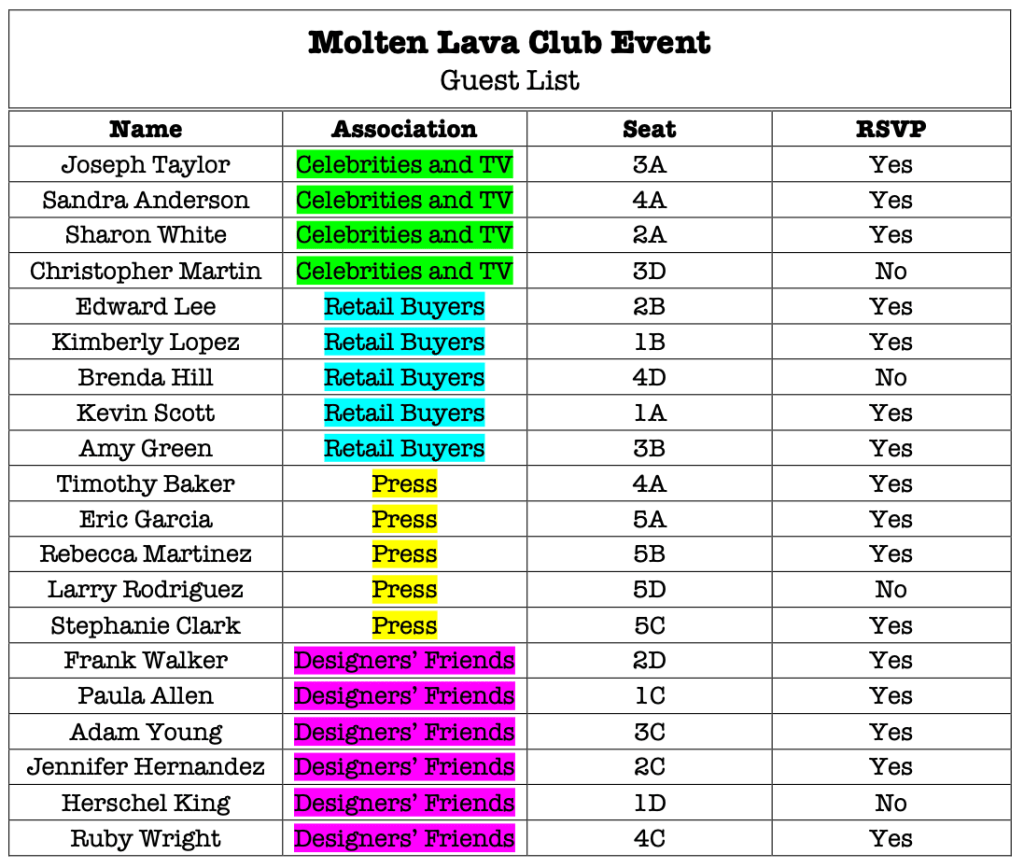
The chief objective behind the seating arrangement is to ensure that the appropriate category of invitees is placed appropriately to produce the most exposure, media attention, and merchandise sales. The guest list and seating arrangement have been based on the scenario that eighty percent of the invited guests have RSVP’d. Because Christopher Martin, Brenda Hill, Larry Rodriguez and Herschel King have not yet RSVP’d, their seats will be pushed to the back row in order to allow space for guests that we know are planning to attend. “Celebrities invited to a show almost always land in the front row and are usually seated together in the middle of the runway, where photographers can get them all in a single shot—also known as the money shot”
(Bourne 2013). This is also a strategic approach in terms promotional exposure of the show. Consumers often mimic what they see their favorite celebrities wearing, and celebrity presence alone can be a great driving force behind positive reinforcement for the client’s brand name. Press will be seated along the end of the runway, “where models pivot, and they get the longest look at each outfit. This is also the easiest spot for them to make a quick exit” if necessary… time is money, after all! (Bourne 2013) The remainder of the seating will incorporate the retail buyers. It is critical for the buyers to get a close look at the merchandise, since they are the deciding force behind which merchandise pieces they put into their stores. The objective, of course, being that the buyers will make purchases from Molten Lava immediately following the show. (Mau 2015)
Works Cited ***WORK IN PROGRESS!!***
“7 Fashion Trends That Will Be Big In 2018.” ELLE UK. 2018 Hearst Magazines UK, 23 Mar. 2018. <www.elle.com/uk/fashion/trends/longform/a40085/fashion-trends-2018/>.Everett, Judith C., Kristen Swanson. Guide to Producing a Fashion Show, 3rd Edition. Fairchild Books USA, 01/2013. VitalBook file.
“Fashion Show Venues.” Wallpaper*. TI Media Limited, 22 July 2008. <www.wallpaper.com/fashion/fashion-show-venues>.
Versitile Warehouse Studios w/ Basement, Two Bars, Cyc & Sets in DTLA in Los Angeles.” Peerspace. Peerspace, Inc., n.d. <www.peerspace.com/pages/listings/5a51adbdfe8aff4300460fdb>.
 STYLE, SITED.
Leave a comment